

Training Day
Or "Mind the [Training] Gap"

Probation comes from the Latin probare, to test, to try, to prove. It is the same root that gives us proof, and probe, and the approbation we extend to something once it has survived scrutiny. A probationary period is supposed to be a period of proving. The employer watches, the new hire performs, and by the end everyone knows whether the person can do the work. That is the theory, anyways, and in most jobs it holds. You can tell inside a few months whether someone can close the register, balance the books, or run the shift.
Forensic science* doesn’t seem to work this way. A study some colleagues and I recently completed set out to explain why, and the answer turns out to have less to do with who we hire than with the systems we hire them into.1
We gathered workforce data from seventeen laboratories, a mix of local, regional, state, and one federal agency, covering more than a thousand employees. We asked plain questions about new hires. Did the person hold a bachelor’s degree, and was it from a FEPAC-accredited program. Did they hold a master’s. When did they start, when were they authorized to work cases independently, and when, if ever, did they leave. From those dates we built three measures:
How long training took,
How long people served after they were authorized, and
How much training investment was lost when someone left before ever reaching independent casework.
The education picture is familiar and, by now, almost boring in its consistency. Bachelor’s degrees are nearly universal, roughly ninety-six percent, which tracks with everything published in the last two decades. The bachelor’s is not a distinguishing credential in this field. But, oddly, what remains scarce is accreditation. FEPAC bachelor’s degrees sat in the low-to-mid teens on average, with a median around 12%, and even among the minority who held a master’s the accredited share was a minority of a minority. Twenty years after FEPAC was stood up2, accreditation is still an episodic, clustered credential rather than a national norm. This is consistent with what Marohl and colleagues reported, only sharper.
You’re Hired! Get to Work!
The training numbers are where the argument lives. For those who finished, training ran about a year, and post-authorization service (meaning work tenure, how long an employee stayed with that job) ran about two and a half. Put another way, the time spent making an analyst is roughly 40% of the productive time that follows, and average tenure is barely twice the length of training. A laboratory that spends a year building an analyst and keeps that analyst for two and a half years is a laboratory that is always building and rarely benefiting from a settled core of mid-career people. It never gets ahead, it just runs faster in the same place, churning employees.

Here’s the kicker: Among those who left before authorization, the average lost training time was longer than the average completed training. Let me say that again: It took longer to train someone who left or failed than it did to train someone who stayed. People who never became productive had, on average, absorbed more days of training than the people who did. That is not a rounding error; that is a Buffalo-Peace Bridge roundabout. It is also where the investment in people goes.3
Here is the mechanism, and here is where probare comes back. The probationary period in most civil-service systems runs twelve months. BUT forensic training runs somewhere between roughly ten months and a bit over a year. An employee who is still in training after the probationary year is a liability.4
The finding that “years lost in training” exceed one year indicates that laboratories routinely identify non-viable analysts after probation has lapsed, at which point exit becomes procedurally difficult and organizationally costly. Probation is meant to be the period of proving. In a forensic laboratory it expires just as proof becomes possible; “the probe” ends before it has probed anything.
It took longer to train someone who left or failed than it did to train someone who stayed. People who never became productive had, on average, absorbed more days of training than the people who did.
Systems Fail, not People
You might be tempted to think that laboratories are hiring the wrong people, and if selection were sharper the losses would shrink. I do not think the data fully support that, and I think the tempting reading is exactly the trap. Local, regional, and state laboratories sit inside jurisdiction-wide human-resources frameworks built for uniformity, procedural fairness, and legal defensibility across hundreds of unrelated job classifications. The people who write the screening criteria and set the probation length are usually not the people who understand how a firearms examiner or a forensic biologist actually becomes competent. The tension between centralized personnel control for all public employees5 and the needs of specialized technical organizations is old and well documented in public administration. Forensic science* inherited it and then handed the consequences to its training programs.
So training quietly takes on a life it was never designed to live. It stops being specialization and becomes remediation, teaching basic scientific theory, instrument fundamentals, quality systems, and documentation that a more aligned pipeline would have established before anyone walked in the door. Training also becomes the field’s de facto sorting mechanism, the place where unsuitable hires are supposed to be caught, except that most laboratories are neither structured nor resourced to run training as an evaluative filter. Instruction falls to skilled analysts who were never trained to instruct,6 working without clear milestones or validated performance markers, and a training system without those things only postpones failure, usually past the point where postponement is expensive.7
Systems, systems, systems
None of this is a story about lazy managers or weak graduates.8 It is a story about four systems, education, hiring, probation, and governance, each of which is locally reasonable and none of which was designed with the others in mind. But we keep studying them one at a time. We convene panels on curriculum, we argue about accreditation, we run needs assessments on retention9, and each conversation proceeds as though its slice of the pipeline could be fixed on its own.10 The workforce data say otherwise. Short tenure, long training, and lost investment are not four separate problems with four separate owners. They are one problem wearing four costumes, and it will keep reappearing until the field is willing to treat the whole pipeline as a single object of reform rather than a relay of departments passing the trainee, and the bill, down the line.
The distance between the degree a person earns and the casework a laboratory needs (“the gap”) is the real subject here. We have simply built a system that pretends it just one step, right up until the moment probation ends and the proving was supposed to have already happened. The Gap needs to be narrowed—it can’t ever be eliminated because of the jurisdictional problem—so that everyone can benefit.
OK, now what?
If probation is meant to be the period of proving, the first fix is obvious: stop ending it before the proving can start. In any jurisdiction where training runs past a year, the probationary clock has to be reset to outlast it, or the whole apparatus of assessment collapses into a formality.
The second is to stop treating every new hire as a blank. A well-prepared graduate and an underprepared one currently receive the same foundational instruction, which is how laboratories end up paying twice for the parts of a scientific education that should already have been paid for once. And, not for nothing, kill any enthusiasm a competen new hire might have for the job. Competency-based assessment at intake, calibrating training to what the person actually needs, would recover much of the time the field is currently spending on remediation it did not agree to provide. Test them out, shorten training time, everyone wins.
The third is to make accreditation mean something operational. FEPAC has spent two decades certifying that programs are built correctly, and the workforce data suggest that employers, when free to act on their judgment, still cannot tell from the credential alone whether a graduate is ready. Nursing and engineering solved this problem by anchoring accreditation to demonstrated competencies rather than program architecture. Forensic science* has not, and until it does, the credential will keep drifting away from the hiring decision it was built to inform.
Underneath all of this sits the least glamorous recommendation and probably the most important one. The field does not routinely collect standardized data on training duration, authorization, and tenure. Without those numbers, no reform can be evaluated, and the next study a decade from now will read very much like this one. The instruments of measurement come first, or the rest is faith.
These are not a menu. Education, hiring, probation, and governance are one system wearing four hats, and a reform to any single stage will be absorbed by the others unless they move together. That is the whole argument, and it is why the recommendations are offered as a set rather than a list. The distance between the degree and the casework is the field’s to close, but it will not close one step at a time.
I’m a big systems guy, as you know if you’re a regular reader of this Substack. In general, we don’t do enough systems thinking but, once you do, you can’t go back. You see it everywhere, in every little inefficiency, every customer-facing experience no one at that particular place considered (or did and still made the wrong choice), every time you stop somewhere and think, “What am I supposed to do next?”. I live in Buffalo, NY, and we have the luxury of being very close to our Canadian neighbors. Spend any amount of time here, however, and you might accidentally end up in Canada. Here’s the exit:

The Peace Bridge takes you to Canada; Niagra Street keeps you in the US. You have about 2 seconds to make the right choice. People do it all the time (about 20 times a day, according to Canadian border agents); sometimes, they end up in custody. That sign is…not a good sign. You come through that roundabout and go, “Wait? What? Which?” and the next thing you know, it’s all “Oh Canada” and Tim Hortons and kilometers. NYDOT put up temporary electronic signs saying, “TO CANADA ONLY.” A too-small bandaid on a very large boo-boo. Also, you can blame GPS “systems,” (or, in the spirit of this Substack, systems*) that sometimes don’t work like they should.
TL;DR. While at West Virginia University, my office ran the NIJ-funded the Technical Working Group on Education and Training in the United States. That working group’s report formed the basis for the FEPAC standards. Disclosure: I was Chair of FEPAC for 6 years. The goal was to put more science in forensic science* educational programs. We were partially successful.
And, make no mistake, people are the most expensive thing in a forensic laboratory, about 70-80% of the annual budget. Oh, sure, that GC-MS cost a ton of cash, but that was a one-time purchase; employees cost money every year, including salary, benefits, facilities (more people, more infrastructure), etc.
I know of one federal laboratory that put a trainee through seven mock trials. SEVEN. SeVeN! Different ones! The trainee kept failing and the agency kept giving them new opportunities to fail because they had no stopping rule for training goals. Is it really that hard, people?
With no disrespect to any civil servant, it does not take as long to train someone to give you an eye test at the DMV as it takes to train someone on capillary electrophoresis, real-time PCR quantitation, rapid microfluidic systems, and massively parallel sequencing to do DNA analysis. But the rules were written around the mass of government employees, not the exceptions.
Even if you don’t want to admit it, not everyone can nor should teach. You’ve sat through many bad presentations, be honest. Think back to your worst college class lecturer—and they were supposedly a professional teacher. Guess what? No one taught them how to teach, either. Bigger system, bigger problem, maybe even a wicked one.
The BOTN (back of the napkin, for you obscure acronym afficionados, or OAAs) estimate for the training cost of a scientist is twice their annual salary. Twice. Double. Show me that line item in the budget.
Really? I’m just softballing these in like this? That’s why I don’t turn on Comments for this thing.
My favorite is the “If you leave this job early, you’ll owe us money.” See you in court, Bluff Boy. Another phenomenon is labs that are really good at training but can’t hold onto employees. You think other labs don’t know this? There are some labs that are “farm teams” for other labs that can pay more or are in a more attractive location. They wait until training ends, then scoop up an already-trained person, cutting their new training time significantly. I won’t dime anyone out; the hunters know who they are.
Kind of a Swiss Cheese Model of Failure. The model, developed by psychologist James Reason, illustrates how catastrophic errors occur when systemic defenses and safeguards fail. Each line of defense is represented by a “slice of Swiss cheese” with holes representing inherent weaknesses. Bad things happen only when these holes momentarily align across all defensive layers, letting a hazard through.
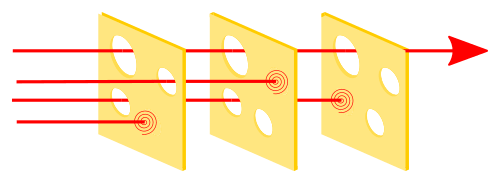
That big arrow at the top? That’s the post-probationary new hire you can’t get rid of. Congratulations.