

Bad Dog, New Tricks
Why exchanging physical measurements of your noggin with scans of your inner noggin aren't any better. Dad joke: "I had a brain scan once and the results came back negative."

In 1876, an Italian army physician named Cesare Lombroso published L’uomo delinquente (The Criminal Man), a book built on calipers and skulls.1 Lombroso had spent years measuring the craniums of soldiers, prisoners, and cadavers, convinced that criminality had a physical signature: a sloping forehead, an asymmetric jaw, an overdeveloped brow ridge. He called the result atavism, the idea that some people were born as evolutionary throwbacks, biologically predetermined toward violence.2 Italian courts took him seriously. So did prosecutors and, for a while, so did a fair swath of European science. It took decades of failed replication and mounting embarrassment before criminal anthropology lost its grip on the courtroom, and even longer before its underlying premise, that guilt could be read off the body, was treated as the pseudoscience it always was.
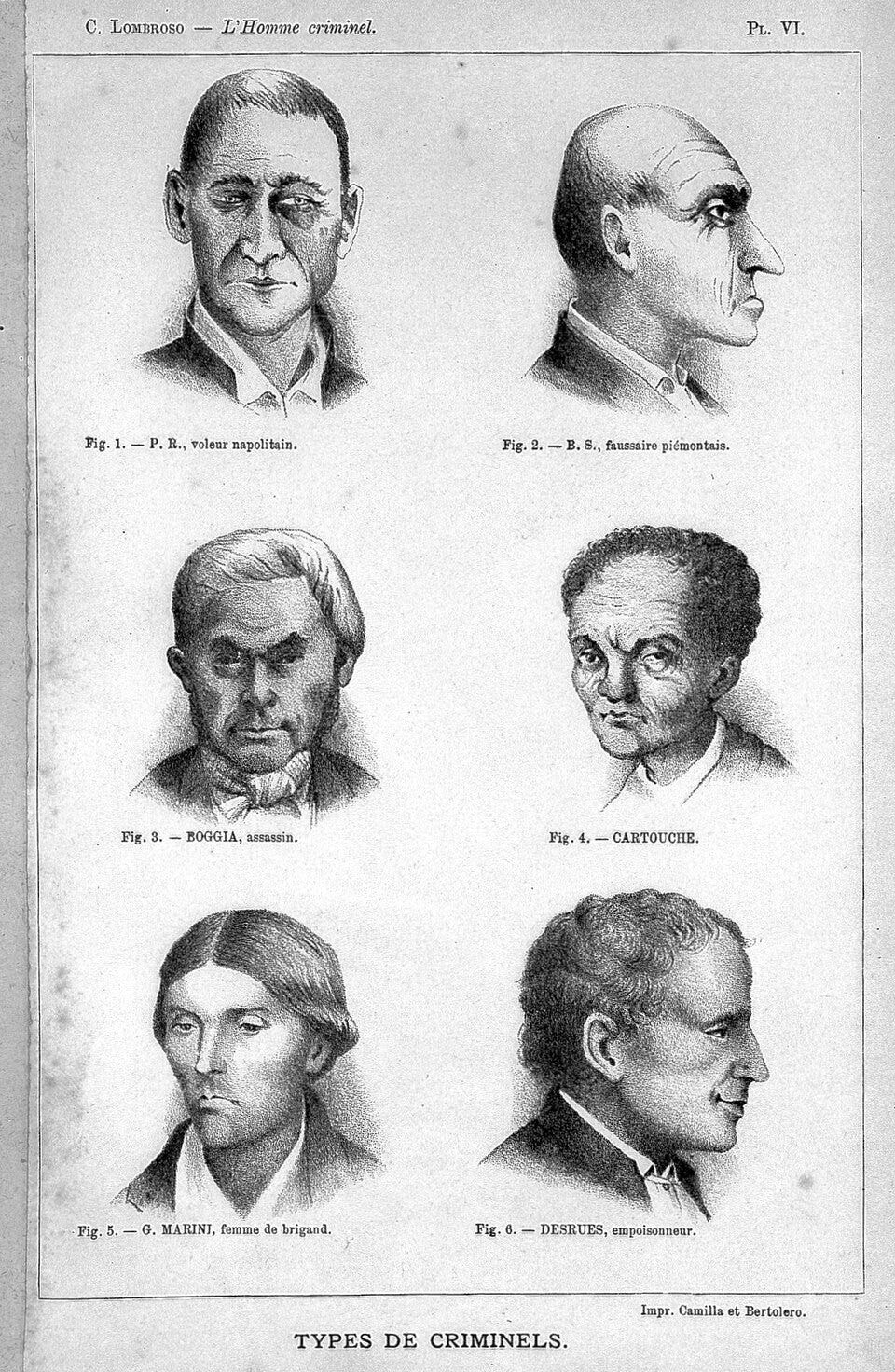
I think about Lombroso every time a new claim surfaces that we have finally found where violence lives in the brain. The Guardian’s recent investigation3 into Kent Kiehl, the University of New Mexico neuroscientist who has spent three decades running a mobile MRI unit through American prisons, is the latest occasion. Kiehl did not invent the idea that psychopathy has a neurological signature, but he built the infrastructure to sell it to courts: a portable scanner, a database of thousands of incarcerated brains, and a research career organized around correlating scan results with the Hare Psychopathy Checklist-Revised. Since Brian Dugan’s 2009 capital sentencing, when Kiehl’s testimony about reduced grey matter in Dugan’s emotion-processing regions was offered as mitigation, his findings have moved from the lab into active use by defense counsel and, per the Guardian’s reporting, into arguments that have cut the other way for other defendants.
The order matters
Forensic disciplines that work, the ones we trust enough to convict or exonerate on, earned that trust through a specific sequence. DNA typing went through a long, contentious period of population genetics debate, proficiency testing, and error rate studies before it settled into the courtroom staple it is today, and even then the 2009 National Academies report found the sequence had been skipped or rushed for (at least) half the field. Fingerprint comparison, bite mark analysis, and hair microscopy are still paying for having reversed that order, entering courtrooms on the strength of practitioner confidence rather than validated error rates, and only being forced through belated scrutiny after wrongful convictions piled up. The lesson from that history, one that OSAC and NIST have spent a decade trying to operationalize into actual standards, is that validation has to precede adoption. A method has to prove what it can and cannot measure, in a defined population, with a known error rate, before anyone puts a person’s liberty behind it.4
Neuroimaging for psychopathy skipped the line. It did not arrive in court by way of a standards body or a published error-rate study accepted by consensus; rather, it arrived because a defense attorney invited a credentialed scientist into a specific case, hoping the jury would find grey matter density more persuasive than character testimony. That is advocacy, not validation, and the two get confused constantly in American courtrooms because both wear the same costume of expert testimony. The Guardian’s account of a 2019 retraction, in which Kiehl’s team pulled a paper linking psychopathic traits to reduced corpus callosum volume after the data turned out not to support the conclusions, is not a scandal so much as a symptom of what happens when a field’s central claims are still being worked out in real time while the same claims are simultaneously being used to argue for a someone’s execution or exoneration. Science is allowed to be wrong on the way to being right. However, the problem is that courtrooms are not equipped to wait for that process to finish,5 and neither are the people whose sentences depend on it.
A tool with no direction
The part of the Guardian piece I keep returning to is the double use. The same body of research that has been offered to spare defendants from execution has also, per the reporting, been marshaled toward the opposite end, framing a defendant’s brain as evidence of enduring dangerousness rather than diminished culpability. This is a demonstration that the science does not yet know what it is measuring, IMHO. A finding of reduced activity in the orbitofrontal cortex can be read as an explanation that reduces moral responsibility, or as a prediction that increases perceived future risk, and nothing in the underlying data tells you which reading is correct, because the discipline has not established what the finding actually predicts about behavior, treatment response, or recidivism with anything like the precision the courtroom framing implies. An immature science is directionless, not neutral, which means it gets pointed wherever the most persuasive advocate in the room points it.
I have argued that forensic disciplines should be organized around evidentiary function, what a method can actually tell an investigator or a jury, rather than around the laboratory’s internal sense of its own sophistication. Neuroimaging is a sophisticated laboratory technique but it is not, yet, an evidentiary one, because sophistication and evidentiary validity are answering different questions. The first asks whether the instrument can detect something real in the tissue. The second asks whether that detection reliably maps onto a legal fact, culpability, dangerousness, capacity, in a way that has been tested against ground truth and found to hold up. Kiehl’s lab has done a great deal of the first kind of work. The Guardian’s reporting suggests the second kind of work, the kind that actually justifies a scan reaching a jury, remains thin, contested, and in at least one instance, retracted.
Same sin, better resolution
Lombroso’s calipers are a punchline now, a museum piece next to phrenology6 charts and other Victorian confidences we have outgrown. But the impulse behind them was never really defeated, it was just waiting for better instruments. A caliper measures a skull to twentieth-of-an-inch precision and calls it destiny; an fMRI measures blood oxygenation to a few millimeters of spatial resolution and, in the wrong hands, calls it the same thing. The resolution has improved enormously. The epistemic overreach of treating a physical measurement as a direct readout of moral character has not changed at all, and it will keep recurring in forensic science* until the courts internalize that a method’s technical sophistication is not evidence of its courtroom readiness.7 Validation is slow, unglamorous, and comes before the invitation into the arena of the court, not after. Every time we let a discipline skip that order because the pitch is compelling enough, we are running Lombroso’s experiment again, just with a bigger, fancier, more impressive-looking machine.8
Anthropologists have been fascinated by skulls because they serve as a biological and cultural archive. The human cranium provides a wealth of information regarding human evolution, ancestral migration patterns, and diet (teeth are the only part of the skeleton that comes in direct contact with the environment). Additionally, skulls may reveal cultural practices and are used in solving forensic cases. Historically, their fascination with skulls is tied to a damning legacy. In the 19th century, practitioners of “scientific racism,” such as Samuel Morton, and pseudoscientists in phrenology used skull measurements to justify colonial hierarchies and racist ideologies. Modern anthropology grapples with this problematic heritage by actively repatriating human remains and studying historical collections to expose past biases.
For Lombroso, criminals are distinguished from noncriminals by multiple physical anomalies, like sloping brows, asymmetric features, narrow eyes, etc. You’re looking in the mirror, now, aren’t you? These features are either adaptations or spandrels, phenotypic traits that are byproducts of the evolution of some other characteristic selected for but not for that byproduct itself. He postulated that criminals represented a reversion to a primitive or subhuman type of person characterized by physical features reminiscent of apes, lower primates, and early humans and to some extent preserved, he said, in modern “savages” (ouch). The behavior of these biological “throwbacks” will inevitably be contrary to the rules and expectations of (WESTERN) modern civilized society. And guess who fit these descriptions? “Foreigners,” of course; those people from “other” places that didn’t fit the bill of “civilized” peoples. Lombroso’s theories were disapproved throughout Europe, especially in medical schools, especially Alexandre Lacassagne in France. Lombroso’s legacy is a cautionary tale about biological determinism, the wrong-headed idea that human behaviors, intelligence, and moral failings are genetically hardwired and immutable. Theories like Lombroso’s are used by conservative thinkers to blame individuals and their biology (which can’t be fixed, so let’s sertilize them or put them in prison) for crime and poverty, thereby drawing attention away from systemic societal oppression and institutional problems (which can be fixed by altering the status quo, god forbid).

Thanks to my dear friend and colleague, Raychelle Burk, for bringing this article to my attention.
In theory. In practice, well, that’s a different issue we’re still struggling with. But, as my dad used to say, “No problems, no jobs.” He also used to tell me unpleasant things were better than “a jab in the eye with a sharp stick,” which is a pretty low bar for unpleasantness. Stub your toe or lose sight in your left eye…thanks for the perspective, dad. :-|
Technology leads, society lags, law drags. This dynamic is often called the pacing problem and it explains how innovation outpaces human adaptation and legal oversight. Technology is built exponentially, social norms adjust organically, and legislation requires slow, deliberate, bureaucratic processes. This phenomenon creates profound frictions across modern life. No shit, Sherlock. E.O. Wilson once said humans have “paleolithic emotions, medieval institutions, and godlike technology.” What could possibly go wrong? Oh, just everything all the time…
Phrenology is a discredited pseudoscience from the early 19th century that claimed personality traits and mental faculties could be determined by measuring the shape and bumps of a person’s skull. Developed by German physician Franz Joseph Gall, phrenology operated on the belief that the brain was the organ of the mind and was divided into specific, localized areas responsible for different traits (such as combativeness, cautiousness, and benevolence). So far, so good. Gall and his followers theorized that if a person heavily used a specific mental faculty, the corresponding brain area would grow, creating a noticeable bump or enlargement on the overlying skull. Conversely, a depression in the skull indicated an underused trait. Whoops. Sounds awfully Lamarckian to me.
Which, of course, they won’t, because the attorneys are more worried about making their case and the judges are more worried about being overturned on appeal. Scientists sit on the sidelines (or in the witness room) passively waiting to be called. Not what I would call a robust process of offering valid science to the judicial system, but we don’t run the circus, they do.
Calipers don’t impress anyone, even those of us who use them. Basically, they’re rulers with slides or hinges. [Wiggles fingers]: Oooooh, magic. But flashing lights and noises draw us in (see prehistoric emotions above).